Terry & Tub is reader-funded. Every buy button here goes to Amazon and earns us a commission at no extra cost to you. Brands we cannot earn from are reviewed anyway when they are the right answer, with a citation instead of a buy button. Full disclosure.
The single biggest change is geometry, not heat: hang a towel spread out as one layer rather than folded over a rail, and it dries roughly twice as fast, because both faces get air instead of two faces being pressed together. After that, in order of effect -- spin the wash at the highest speed the machine allows, dry on medium heat with a clean lint filter rather than high heat with a blocked one, do not overfill the drum, and ventilate the bathroom for twenty minutes after the shower rather than two. A lighter towel in a quick-dry weave does the rest on its own.
Dry time is the thing that quietly ends towels. A towel that starts every shower slightly damp grows bacteria in the pile, which is what the musty smell is. The usual response is more detergent and hotter washes, which strips the cotton and leaves the towel thin and gray within a couple of years. Fix the drying and the rest of the problem disappears.
Why a folded towel barely dries
Fold a towel in half over a rail and you have four faces of cloth, two of them pressed against each other. Those two inner faces have no air across them at all, so water can only leave them by migrating sideways to the edges -- slowly, and into cloth that is already wet.
Hang the same towel spread out, from a hook or across a rail in one layer, and it is a single sheet with air on both sides. Nothing about the towel changed and it dries in roughly half the time. This is why hooks beat rails in practice: not because a hook is better engineering, but because hanging a towel on a hook takes no care, and spreading a towel properly across a rail takes care that households do not reliably apply.
Drying faster in the dryer
- Spin the wash faster. This is the highest-leverage change available and it happens before the dryer. The highest spin speed on the machine removes substantially more water than a default setting, which shortens the dryer cycle directly.
- Clean the lint filter between loads. A blocked filter restricts airflow, which means a longer and hotter cycle to remove the same water. This is also the single commonest cause of a dryer that seems to have gotten worse.
- Dry on medium, not high. Counter-intuitive but correct over a towel's life: high heat makes cotton brittle, and brittle fiber breaks and lints. Medium costs a few extra minutes per load and buys years.
- Do not overfill the drum. Towels need to tumble to expose different faces to the air. A packed drum is a slow drum, and a drum packed with heavy wet towels is the slowest load a dryer handles.
- Add a dry towel to a small wet load. An old dry towel in with two wet ones genuinely speeds things up by absorbing water off the surfaces. Do not do this with a full load, where it simply takes up space.
- Shake each towel out before it goes in. Towels come out of a spin cycle compressed into a disc. Shaking them loose first means they tumble properly from the start.
Dryer balls are worth the small cost -- wool ones separate the load and keep air moving between items. Dryer sheets are not: they deposit the same coating fabric softener does, which reduces absorbency permanently.
Drying faster without a dryer
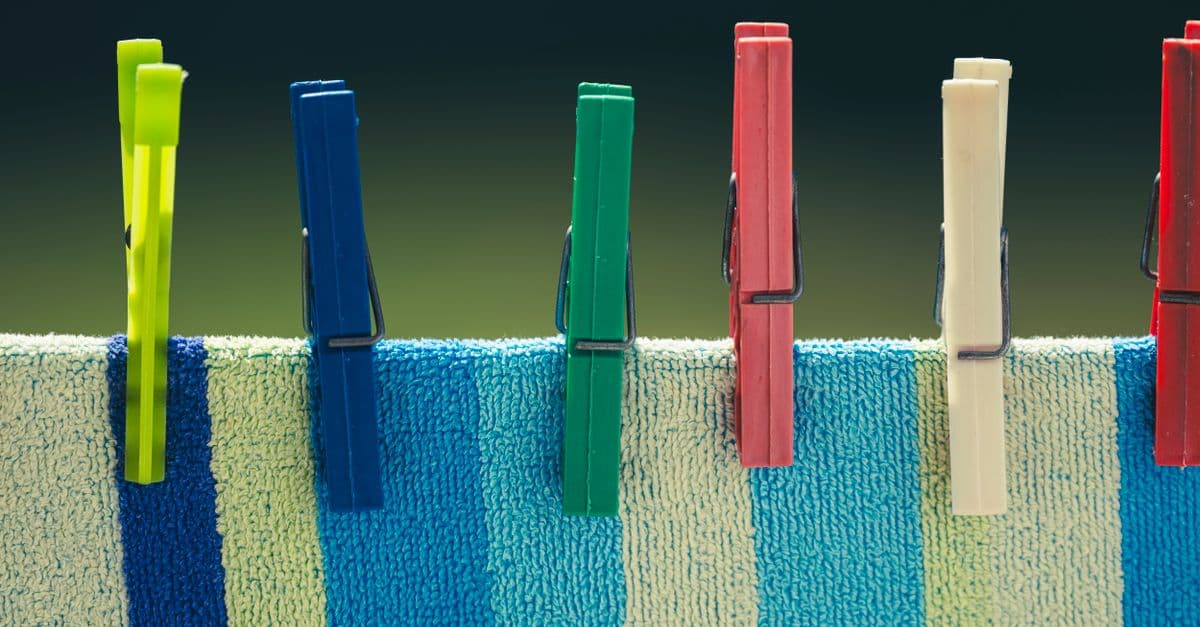
Line drying outside beats a dryer on almost every measure except speed in bad weather, and in sun it is close on speed too. Hang towels along the long edge rather than folded over the line, peg both top corners, and leave a gap between items -- towels touching each other is the same problem as a folded towel, at a larger scale.
Indoors, the constraint is not heat but air exchange. A clothes airer in a closed room with a radiator on raises the humidity until evaporation stops, and the room then smells of damp laundry. An airer in a room with a window cracked open, or with a fan pointed at it, dries faster than the same airer next to a hotter radiator in a sealed room.
- Space items on the airer so nothing touches. Half as many towels drying twice as fast is the same throughput and a much better smell.
- Point a desk fan at the airer. Moving air is worth more than warm air -- this is the cheapest single upgrade to indoor drying.
- Never dry laundry in the bathroom. It is the room least able to clear humidity and the room where everything else already struggles to dry.
- Roll a towel in a dry towel and press before hanging, if it has come out of a hand wash. It removes a surprising amount of water in ten seconds.
Drying faster in a small bathroom
A small bathroom with one towel rail and a weak extractor is the hardest case, and it is extremely common. Three things change it.
Run the fan for twenty minutes after the shower. Most of the moisture leaves the room after the shower ends, not during it, and most extractors are switched off within seconds. If the fan is wired to the light, that is worth changing. If there is no fan, leave the door open.
Add hooks. A hook takes a towel in one layer, costs very little, and gets used reliably. Two hooks in a small bathroom beat one heated rail that everybody folds towels over. A towel with a hanging loop makes this effortless -- the looped towel picks cover that properly.
Squeegee the shower. It sounds fussy and it removes a meaningful share of the water that would otherwise evaporate into the room and then into your towels.
Towels that dry on their own
Weight and weave do most of the work before any habit does. Below about 600 GSM a towel will generally dry between daily showers in a reasonable bathroom; at 800 GSM and up it will not, regardless of what you do with it.
Weave matters as much. An open waffle or a ribbed quick-dry structure exposes far more surface area to air than deep terry pile does, which is why a 410 GSM waffle towel can be dry in a fraction of the time of a 700 GSM plush towel. Waffle versus terry is the full comparison, and the quick-dry roundup has the picks in depth.
Three towels chosen on dry time: the fastest weave, the quick-dry weave at an everyday weight, and the looped multipack that makes hanging effortless.
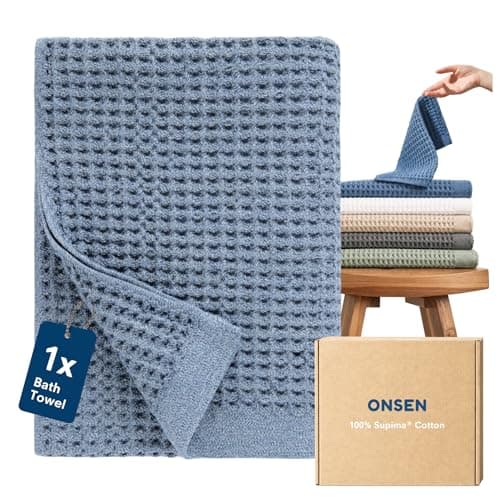
Fastest honest dry time
Onsen Supima Waffle Bath Towel
An open waffle weave in 100% USA-grown Supima cotton at roughly 410 GSM, built to dry in a fraction of the time a plush terry towel needs.
#ad How we are funded · Price as of November 3, 2026
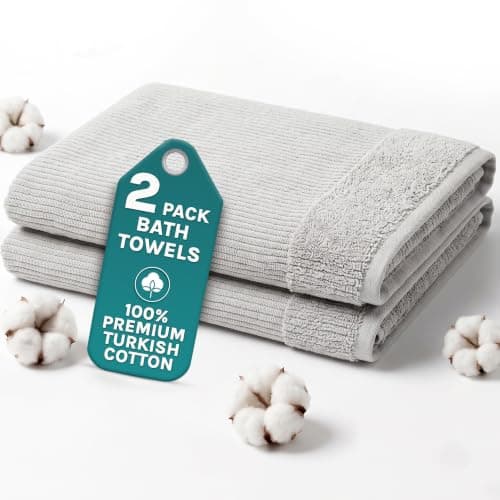
The loop towel that publishes its weight
Arconiz Pure Basics Ribbed Bath Towel
500 GSM of 100% Turkish cotton in a ribbed quick-dry weave at 56 x 30 in, with a hanging loop -- the only loop towel we found that publishes a weight, a fiber and a weave together.
#ad How we are funded · Price as of November 3, 2026
Four looped towels in one order
SEMAXE Cotton Bath Towels with Hanging Loop, 4-Pack
A four-pack of 100% cotton bath towels at 55 x 27 in with a hanging loop on every piece -- the cheapest way to make a whole rail hook-friendly at once.
When slow drying is actually a build-up problem
If towels have become slower to dry than they used to be, the towel has probably not changed -- what is in it has. Fabric softener, dryer sheets, excess detergent and hard-water minerals all leave coatings in the pile that trap water and block airflow between fibers.
The symptom pair is distinctive: the towel feels fine dry but pushes water around rather than absorbing it, and it takes longer to dry than it did when new. That is build-up, not wear. How to strip towels resets it in an afternoon, and why towels stop absorbing water explains the mechanism.
After the reset, the maintenance is short: half the detergent, no softener, an extra rinse, and a high spin. The hotel laundry method is that routine in full.
Frequently asked questions
How do you dry towels faster?
Hang them spread out as a single layer rather than folded over a rail -- that alone roughly halves the drying time, because both faces get air instead of two faces being pressed together. Then spin the wash at the highest speed available, dry on medium with a clean lint filter rather than high with a blocked one, and do not overfill the drum.
Why do my towels take so long to dry?
Usually three reasons stacking up: they are folded rather than spread, so half the surface has no airflow; the spin speed left too much water in them; and the bathroom does not clear its humidity. If they have become slower over time, add a fourth -- fabric softener and detergent residue coating the fibers.
Should you dry towels on high heat?
No -- medium is better. High heat makes cotton brittle, and brittle fiber breaks, lints and thins at the fold lines, which is what ends a towel's life. Medium adds a few minutes per load and adds years to the towel.
How do you dry towels without a dryer?
Hang them spread along a line or airer with a gap between items so nothing touches, and prioritize moving air over warm air -- a desk fan pointed at an indoor airer does more than a hotter radiator in a sealed room. Never dry laundry in the bathroom, which is the room least able to clear humidity.
Does adding a dry towel to the dryer speed it up?
With a small load, yes -- a dry towel absorbs water off the wet items and shortens the cycle. With a full load it does not help, because it simply takes up space that the wet towels need in order to tumble.
Do dryer balls help towels dry faster?
Wool dryer balls do help a little by separating the load and keeping air moving between items. Dryer sheets do the opposite over time -- they deposit the same kind of coating fabric softener does, which reduces absorbency permanently.
What towels dry the fastest?
Light towels in an open weave. An open waffle at around 410 GSM or a ribbed quick-dry weave at 500 GSM exposes far more surface to air than deep terry pile does. Below about 600 GSM a towel will generally dry between daily showers; at 800 GSM and above it will not, whatever you do with it.