Terry & Tub is reader-funded. Every buy button here goes to Amazon and earns us a commission at no extra cost to you. Brands we cannot earn from are reviewed anyway when they are the right answer, with a citation instead of a buy button. Full disclosure.
The flat stripe or band across a bath towel, a few inches in from each short end, is called the dobby border. It is a strip of tight, flat, pile-free weave produced on a dobby loom attachment, and it is structural: it anchors the terry pile, stops the cloth stretching lengthways, and gives the hem something firm to be stitched into. It is not decoration, and a towel without one is usually a towel made as cheaply as possible.
Nearly every bath towel sold has one, almost nobody knows what it is for, and it is one of the few visual details on a towel that reliably predicts how long the towel will last. Once you know what you are looking at, you can read it from a product photograph.
What the dobby border does
A terry towel is made of two warp systems. One is the ground warp, held under tension, which is the actual fabric. The other is the pile warp, fed in slack, which loops up to make the terry. That slack pile warp is what makes a towel absorbent and it is also what makes a towel structurally floppy -- the loops are not carrying any load.
The dobby border is a band where the pile warp is dropped out and the cloth is woven flat and tight. That does three things at once:
- It anchors the pile. The loops closest to the end of the towel are the ones most likely to be pulled out, by a watch, a ring, a rough rail bracket or a washing machine agitator. The border terminates the pile field in solid cloth rather than at a raw edge.
- It stops the towel stretching. Terry stretches lengthways under its own soaked weight. A flat dense band at each end resists that, which is why a well-bordered towel still hangs square after two years while a borderless one goes wavy.
- It gives the hem a foundation. A hem stitched through thick terry pile is stitched through something that compresses and slips. A hem stitched through a flat dobby band is stitched through stable cloth -- which matters, because the hem is where towels fail first.
How to read a border before you buy
Four things are visible in a product photograph and all four tell you something.
- Width. A wider band means more flat cloth doing the structural work. Hotel-supply and hospitality towels have noticeably wide borders for exactly this reason -- they are laundered to destruction and the border is what holds them square.
- Whether it is woven or printed. A woven border has texture: you can see the pile stop and the flat weave start. A printed stripe on continuous pile is decoration pretending to be structure, and it adds nothing.
- Whether both ends have one. Both short ends should. A towel with a border at one end only has had half the structural work removed to save money.
- What happens at the long sides. The long sides should be either a woven selvedge or double-stitched. Single-stitched long sides on a towel with a good border is an odd combination and usually means the border is cosmetic.
The same reading applies to the hem itself. Double-stitched, braided or hemstitched edges get mentioned in a listing because they cost money; silence means a plain folded hem. Our main roundup weights hem construction heavily for that reason, and so does the buy-it-for-life list.
Three towels where the border is built rather than printed -- including one that takes the opposite approach and weaves the structure through the whole cloth.
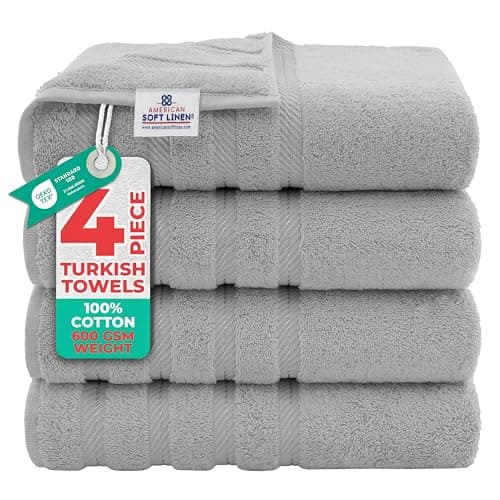
The everyday workhorse
American Soft Linen 600 GSM Turkish Cotton Bath Towel
A 600 GSM Turkish-cotton towel with double-stitched long edges, sitting in the weight band that stays absorbent without taking all day to dry.
#ad How we are funded · Price as of November 3, 2026
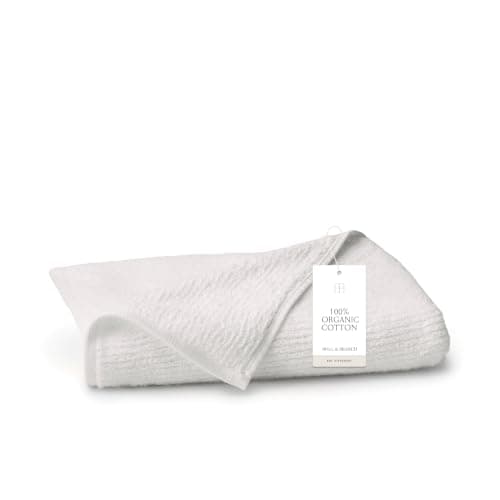
Luxury that bought fiber, not weight
Boll & Branch Turkish Ribbed Bath Towel
Extra-long-staple organic Aegean Turkish cotton in a channeled ribbed weave -- a luxury brand that spent the money on fiber and airflow instead of grams.
#ad How we are funded · Price as of November 3, 2026
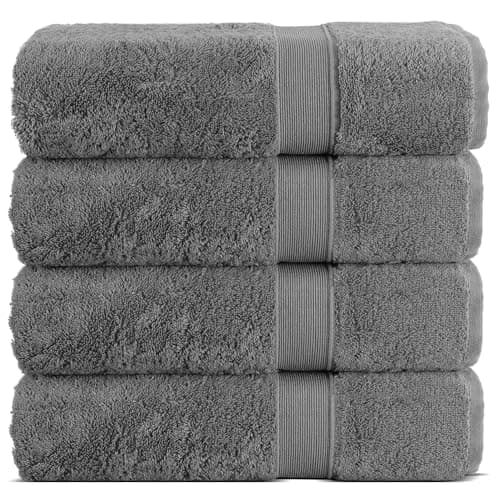
Hotel feel at a hotel-supply price
Chakir Turkish Linens Hotel & Spa Bath Towel
A 550-600 GSM long-staple Turkish cotton towel built to the hotel-and-spa spec, which is exactly the crisp, medium-weight towel most people are actually trying to buy.
Towels that have no border, and when that is fine
Two categories of towel legitimately have no dobby border, and neither is a compromise.
The first is flat-woven Turkish towels -- peshtemals. There is no pile warp to anchor, because there is no pile. The structure comes from the flat weave itself and the ends are finished with hand-tied tassels or a hemstitch instead. The peshtemal guide covers how those ends are finished and what to look for.
The second is waffle and ribbed weaves, where the geometry runs through the entire cloth rather than being confined to a band. A ribbed towel is alternating short and long loop channels from end to end, which anchors the pile continuously. Boll & Branch's ribbed towel is the clearest example of that approach, and waffle versus terry is the full comparison.
What should worry you is a conventional deep-pile terry towel with no border and no alternative structure -- pile running straight into a folded hem. That is the construction that goes wavy at the ends, frays at the hem and pulls loops out of the corners, and it is almost always the cheapest towel on the shelf.
Why hotel towels have the widest borders
Hospitality laundries are brutal: high temperatures, industrial alkaline detergent, aggressive extraction, and tunnel finishers. A towel in that cycle is being stretched and compressed hundreds of times a year rather than dozens.
So hotel-spec towels are engineered around the failure modes that cycle causes, and the wide dobby border is the main one. It is also why hotel towels look plainer than retail towels -- the border is wide and undecorated because it is doing a job, and the rest of the towel carries no pattern that could fade unevenly. Why hotel towels feel different covers the rest of that engineering, and the hotel-quality picks are the ones built to that standard for a home bathroom.
The stripe that is not a border
One more thing worth separating out, because it causes confusion. Some towels carry a narrow woven stripe in a contrasting color somewhere in the pile field -- often near the border, sometimes several of them. That is a color stripe woven into the terry, and it is decoration.
It is not harmful, but it is the part of a towel most likely to bleed in the first few washes and the part most likely to fade out of step with the rest. If you are buying white towels specifically so they can be oxygen-bleached back to white forever, a contrasting woven stripe quietly removes that option. Keeping white towels white only works on towels that are white all over.
Frequently asked questions
Why do towels have a stripe across them?
That band is the dobby border -- a strip of flat, tight, pile-free weave a few inches in from each short end. It anchors the terry pile so loops cannot pull out at the ends, stops the towel stretching lengthways under its own soaked weight, and gives the hem stable cloth to be stitched into.
What is a dobby border on a towel?
A flat woven band produced by a dobby attachment on the loom, which controls individual warp threads. On a towel it is the strip near each end where the pile stops and the cloth is woven flat and dense. The subtle woven pattern you often see in it is a product of the mechanism rather than a styling decision.
Are towels without a dobby border worse?
Usually, with two exceptions. Flat-woven Turkish peshtemals have no pile to anchor, and waffle or ribbed towels run their structure through the whole cloth instead of concentrating it in a band. A conventional deep-pile terry towel with no border and a plain folded hem is the one to avoid -- that is the construction that goes wavy and frays first.
Does a wider dobby border mean a better towel?
As a rule, yes. More flat cloth means more of the structural work is being done properly, which is why hotel and hospitality towels have noticeably wide borders -- they are laundered far harder than home towels and the border is what keeps them square.
What are the lines woven into a bath towel?
If they are in the flat band near the ends, they are the dobby weave pattern and they are structural. If they are colored stripes running through the pile itself, they are decoration -- and they are the part of the towel most likely to bleed early and fade unevenly later.
Which way up should the dobby border go?
It makes no functional difference, and both ends of a bath towel have one. In hotels the border is usually positioned to face outward when the towel is folded in thirds, which is a presentation convention rather than anything to do with performance.