Terry & Tub is reader-funded. We earn a commission on some links to Amazon at no extra cost to you, and we mark those links. Products we cannot earn from are included anyway when they are the right answer, and labeled as such. Full disclosure.
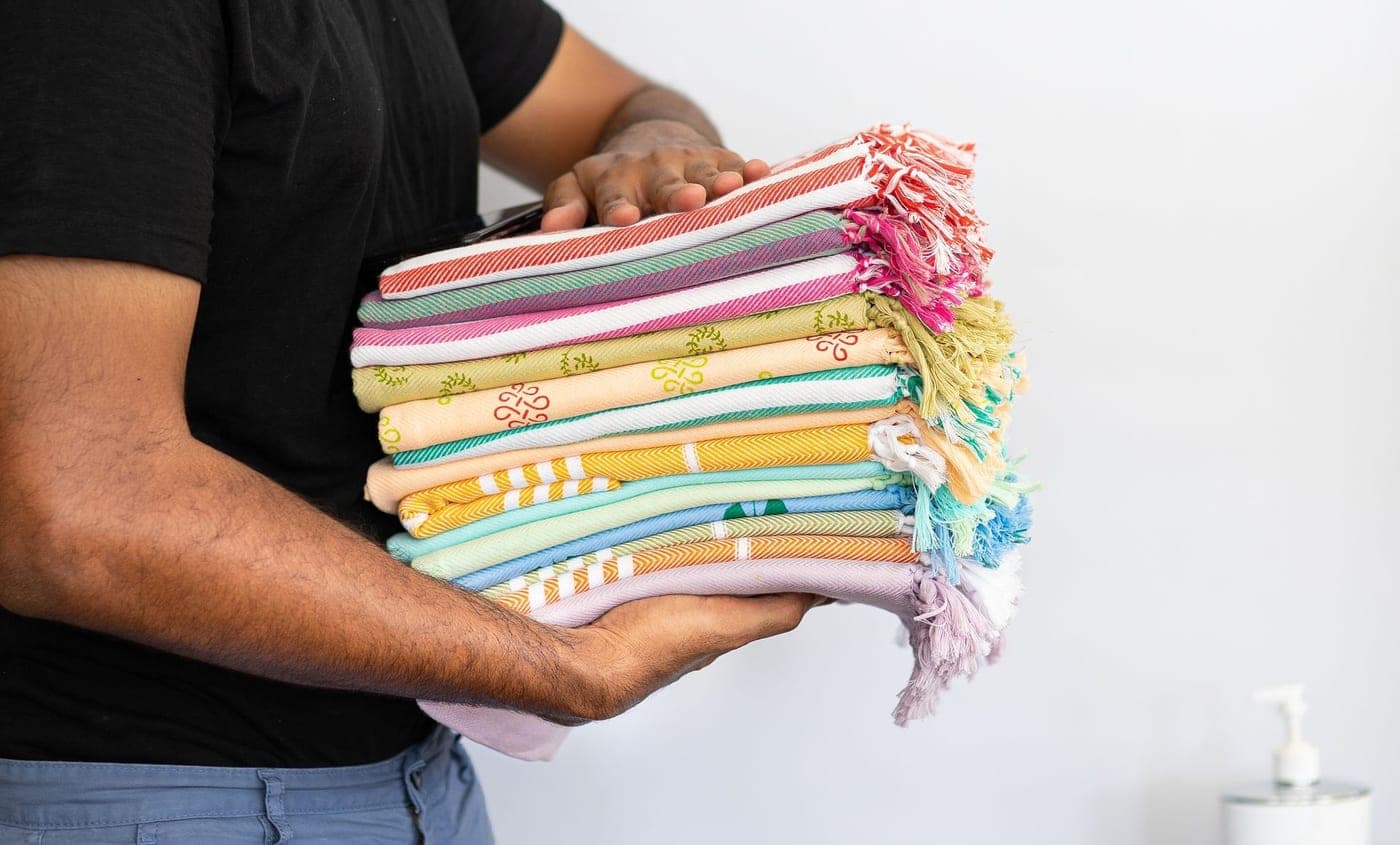
A peshtemal is a flat-woven cotton cloth, traditionally used in a Turkish hammam, typically 36 x 70 in with knotted fringe at both ends. It has no pile, so it dries in an hour or two and packs to a third of a terry towel's bulk.
Where the peshtemal comes from
The cloth predates the terry towel by a very long way. In a Turkish hammam, where the air is hot and saturated, a thick absorbent towel is exactly wrong: it would never dry, and it would be unbearable to wrap in. What works is a thin flat-woven cloth that wipes water away, wraps around the body, and dries almost as fast as skin does.
That design brief -- humid room, repeated use, minimal storage -- turns out to describe a great many modern bathrooms rather well, which is why the peshtemal has had a second life as a domestic towel outside Turkey.
Peshtemal, fouta, hammam towel: the same thing?
Broadly yes, with regional differences that retailers mostly ignore:
| Term | Origin | What it usually means now |
|---|---|---|
| Peshtemal / pestemal | Turkey | The standard term. Flat-woven cotton with fringed ends |
| Hammam towel | Generic | Marketing term for the same cloth |
| Fouta | Tunisia, North Africa | The same idea; often a flatter, tighter weave |
| Turkish towel | Retail | Ambiguous -- may be a peshtemal or Turkish cotton terry |
The ambiguity of the last one is the source of most confusion in the category. We untangle it here.
The weaves you will encounter
- Plain flat weave. The simplest and the fastest-drying. The default and usually the right choice.
- Diamond or herringbone (baliksirti, "fishbone"). A patterned flat weave with a slightly textured surface and marginally more grip. Traditional, and it wipes a little better than plain.
- Waffle peshtemal. A honeycomb structure in a flat cloth -- more absorbent than plain flat weave, still far faster drying than terry.
- Terry-backed. Flat face, looped reverse. The hybrid for people who want the absorbency of terry, at the cost of the dry time that makes a peshtemal worth owning.
What to check before you buy
- 100% cotton. Polyester blends are sold in this category and they defeat the point entirely -- they do not soften, they do not breathe, and they hold odor.
- Woven in Turkey, ideally stated. Not essential, but the mills that have been doing this for generations are noticeably better at it.
- Prewashed, if you can get it. It removes the stiff, non-absorbent break-in period that produces most of the category's bad reviews.
- Hand-tied fringe. The tassels are the failure point. Hand-knotted fringe holds; loose machine fringe unravels.
Sizes and what they are for
| Size (in) | Size (cm) | Use |
|---|---|---|
| 36 x 70 | 91 x 178 | Standard. Bath, beach, travel |
| 37 x 70 | 94 x 178 | Standard-plus. The most common premium size |
| 37 x 74 | 94 x 188 | Oversized. Better for wrapping |
| 61 x 82 | 155 x 210 | XL. Doubles as a throw, wrap or picnic blanket |
| 23 x 36 | 58 x 91 | Hand or kitchen size |
Living with one
Hang it flat rather than folded over a narrow rail and it will be dry in an hour. Wash it warm with everyday detergent and no fabric softener, alongside like items so the tassels do not find a zip. Line dry where you can, though a low tumble is fine. Trim stray fringe threads with scissors rather than pulling them.
That is genuinely the whole maintenance routine, and it is why peshtemals last. The full washing guide is here, and if an older one has gone stiff, it is build-up rather than wear -- stripping brings it back.
Other things people use them for
Once there is one in the house, people find uses. A beach towel that does not hold sand. A picnic blanket that folds into a bag. A sarong. A throw over a chair. A changing mat. A summer blanket. None of that is an argument for buying one, but it explains why households that own one peshtemal usually end up owning six.
Frequently asked questions
What is a peshtemal?
A flat-woven cotton cloth from the Turkish hammam tradition, typically 36 x 70 inches with knotted fringe. It has no pile, so it dries in an hour or two and folds to about a third of a terry towel's bulk.
Is a fouta the same as a peshtemal?
Effectively yes. Fouta is the North African name and often a flatter, tighter weave; peshtemal is the Turkish name. Retailers use both interchangeably.
What size peshtemal should I buy?
36-37 x 70 in for general use. Go to 37 x 74 in if you wrap up rather than wipe down, and 61 x 82 in if you want something that doubles as a throw.
How do you stop peshtemal fringe from tangling?
Wash with like items rather than with zips and hooks, and trim stray threads with scissors instead of pulling them. Hand-tied fringe holds up far better than machine fringe.