Terry & Tub is reader-funded. We earn a commission on some links to Amazon at no extra cost to you, and we mark those links. Products we cannot earn from are included anyway when they are the right answer, and labeled as such. Full disclosure.
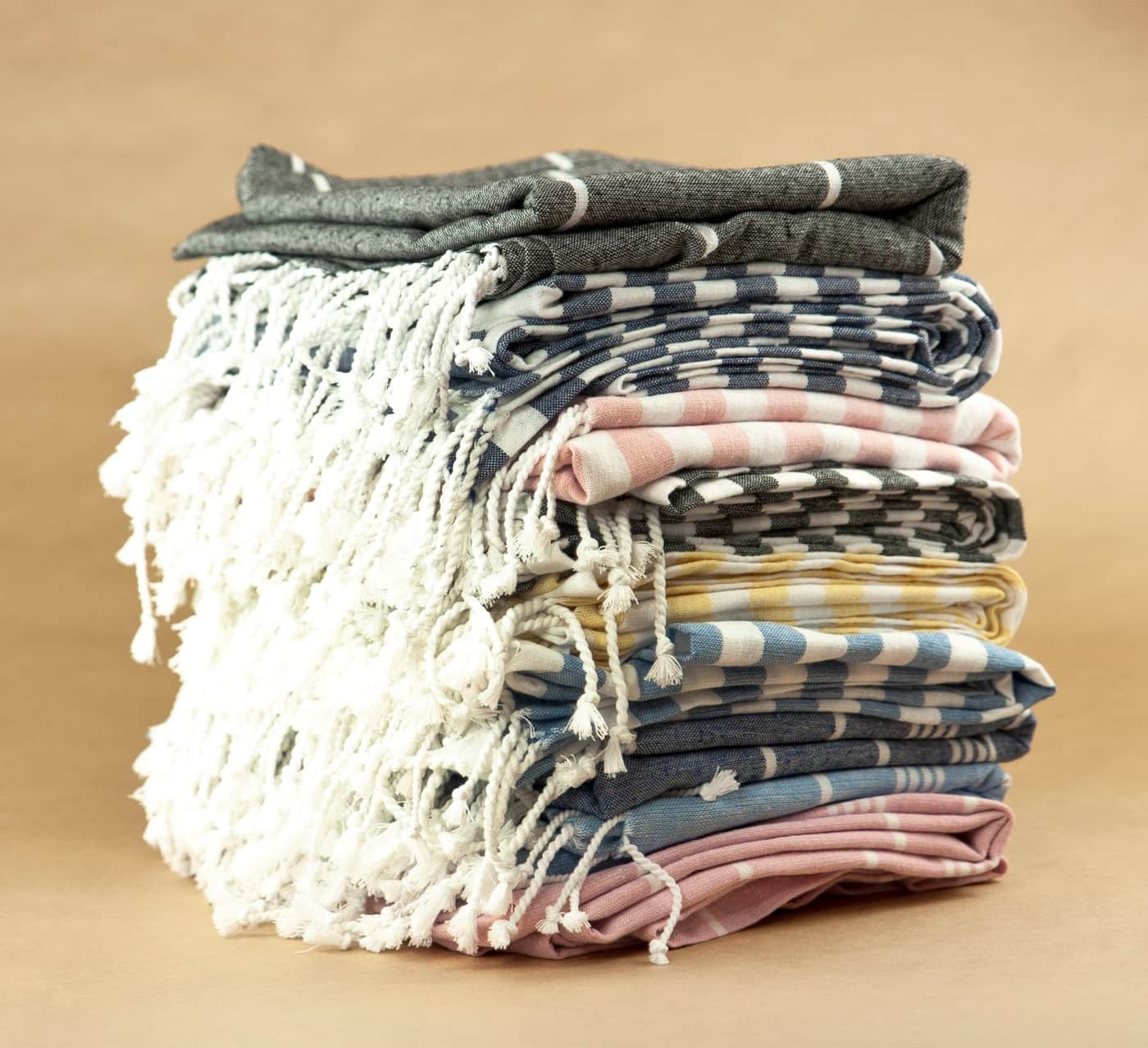
A flat-woven Turkish towel dries in an hour or two, packs to a third of the bulk and softens for years, but absorbs noticeably less than terry. A regular terry towel absorbs far more and takes most of a day to dry. Choose on your bathroom, not on preference.
Nearly all the disappointment in this category comes from a single mistake: buying a flat-woven peshtemal expecting it to behave like a plush terry towel. Bought as the right thing, it is one of the best textiles you can own. Bought as a plush towel, it is a bad plush towel.
Turkish flat weave vs terry at a glance
| Turkish flat weave (peshtemal) | Regular terry | |
|---|---|---|
| Structure | Flat woven, no pile | Looped pile on both faces |
| Absorbency | Moderate -- wipes water away | High -- soaks water up |
| Dry time | 1-2 hours | 8-24 hours depending on weight |
| Bulk folded | About one third of terry | Baseline |
| Weight | Around 330-500 g | 500-900 g |
| First few weeks | Stiff, water-repellent until washed | Works immediately |
| Ageing | Softens for years | Loft flattens over time |
| Failure point | The tasselled fringe | The hem, or a pulled loop |
| Best for | Travel, gym, small bathrooms, humid rooms | Daily bathroom, after a bath, wrapping up |
What the flat weave is better at
Drying itself. No pile means no water held deep in the cloth. A peshtemal on a rail is dry in an hour or two, which is why it effectively never develops the musty smell that plagues terry in a damp bathroom.
Storage. It folds to roughly a third of the bulk of a terry towel with the same coverage. In a flat with one small linen cupboard this is a genuine quality-of-life difference.
Getting better. There is no pile to crush, so instead of the slow flattening that ends a terry towel, a peshtemal simply softens. A five-year-old peshtemal is better than a new one, which is almost unique in household textiles.
Travel and the gym. Packs flat, weighs a few hundred grams, does not go sour in a bag.
What terry is better at
Absorbing. A looped pile holds several times its own weight in water. A flat weave does not come close. If you want to step out and be dry in fifteen seconds, terry is the engineering answer.
Long hair. A peshtemal will not wrap and hold wet hair the way terry does. Most peshtemal converts keep one terry towel for hair.
Working immediately. A new terry towel absorbs from the first use. A new peshtemal takes two or three washes before it works properly at all, and people who do not know that return them.
Feeling plush. No flat weave will ever feel like a good terry towel, and for a lot of people that is the whole point of a towel.
The hybrid, if you cannot choose
A terry-backed peshtemal -- flat weave on the face, looped terry on the reverse -- solves the absorbency complaint while keeping much of the pack-down advantage. Bersuse's Lagos is the version we would buy. It is heavier and slower to dry than a pure flat weave, which is exactly the trade you would expect.
Which should you buy?
- Small or humid bathroom, or a busy household: flat weave. Being dry within two hours is worth more day to day than plushness.
- You wrap up after a shower, or you have long hair: terry. Or terry plus a peshtemal for everything else.
- Travel, gym, holiday house, boat: flat weave, without any hesitation.
- You have never used one: buy a single peshtemal, not a set. Wash it three times before you judge it, and keep your terry towels in the meantime.
Our flat-weave pick
Cacala's peshtemal at 37 x 70 in -- 100% cotton, OEKO-TEX certified, hand-tied tassels. The traditional article rather than an approximation of it. More in the Turkish towel roundup and the peshtemal guide.
Our terry pick
Chakir Turkish Linens at 550-600 GSM: Turkish long-staple cotton in a conventional terry, built to the hotel-and-spa spec. The fiber benefits with none of the adjustment period.
Frequently asked questions
What is the difference between a Turkish towel and a regular towel?
A traditional Turkish towel (peshtemal) is flat-woven with no pile: it dries in an hour or two and packs to a third of the bulk, but absorbs less. A regular towel is looped terry: far more absorbent, far slower to dry.
Are Turkish towels good for drying off?
Yes, with a wiping motion rather than a patting one. They absorb less than terry and need two or three washes before they work properly at all.
Do Turkish towels get softer?
Yes, and unusually so -- there is no pile to crush, so a peshtemal softens for years rather than flattening.
Can you get a Turkish towel that is also terry?
Yes. Terry-backed peshtemals have a flat-woven face and a looped reverse. They absorb like terry and pack smaller than terry, at the cost of a slower dry time than a pure flat weave.